
Protective Device Coordination Study
Time-current coordination to ensure protective devices clear faults quickly while minimizing unnecessary outages and nuisance trips. PE-led coordination studies with full TCC plots for hospitals, laboratories, data centers, campuses, and industrial facilities across the San Francisco Bay Area and Northern California.
Protection that is too slow can damage equipment. Protection that is too aggressive can take down large portions of the facility. Coordination studies find the right balance, and document it in a form your maintenance staff and your AHJ can both use.
What Is A Coordination Study?
A coordination study examines how breakers, fuses, and relays operate together during overcurrent and short circuit events. We develop time-current curves (TCCs) that plot:
- Protective device pickup, time-delay, and instantaneous regions
- Expected fault currents at various points in the system
- Interactions between upstream and downstream devices
- Transformer damage curves, cable damage curves, and motor starting curves where they govern
The goal is for the closest device to the fault to operate first, while upstream devices remain closed, whenever practical. When that holds through the full range of available fault current, the system is selectively coordinated.
Why Coordination Matters
Selective coordination:
- Limits the extent of outages during faults
- Reduces the probability of tripping main devices for local problems
- Helps protect sensitive loads and critical operations
- Supports selective coordination requirements where applicable
- Provides a documented basis for protective settings
- Gives maintenance staff a defensible reason not to change settings in the field
Our Process
- Collect device data and existing settings
- Confirm available fault current from the short circuit model, since TCCs cannot be evaluated without it
- Build the protective device model in the study software
- Plot short circuit levels and protective device curves on TCCs
- Adjust settings to improve selectivity while maintaining adequate equipment protection
- Document recommended settings and any limitations or constraints
- Coordinate with your team and, where needed, your utility or generator vendor
Reading A Time-Current Curve
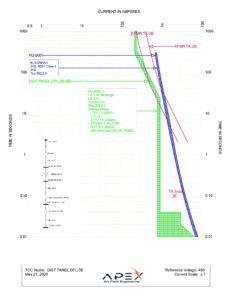
A time-current curve, or TCC, is the working drawing of a coordination study. Current runs along the horizontal axis and time to trip along the vertical, both on logarithmic scales so that hundredths of a second and many minutes fit on one sheet. Reading one is simpler than it looks:
- Higher fault current moves you to the right, and devices trip faster
- Each device is drawn as a band, not a line, because manufacturing tolerance gives a minimum and maximum clearing time
- A breaker band typically shows three regions: long-time for overload, short-time for moderate faults, and instantaneous for severe faults
- Ground-fault protection, where present, plots as its own separate curve
What coordination looks like on the plot
- Two devices are coordinated where their bands do not overlap anywhere in the fault range that can actually occur at that location
- Where bands cross or touch, coordination is lost above that current, and both devices may operate
- A visible margin between bands is what gives the downstream device time to clear first
- Because the bands only need to be clear up to the available fault current at that point, the short circuit study sets the limit of what must be evaluated
We plot every level that matters, down to branch panels where selective coordination is required, rather than stopping at the main switchgear. Curves are delivered legible and labeled, so a maintenance electrician or a plan checker can follow the same reasoning we did.
What We Deliver
- Time-current curves for key feeders and branches
- Recommended breaker and relay settings, including long-time, short-time, instantaneous, and ground fault elements where applicable
- Notes on selective coordination and any necessary trade-offs
- Settings sheets that maintenance staff can use for implementation and verification
- A written summary of assumptions, limitations, and any point where full coordination is not achievable
- Stamped and signed documents where the project or AHJ requires them
What We Need From You
- Existing protective device settings, if available
- One-line diagrams and protective device schedules
- Operational priorities, for example which loads must never trip with others
- Any existing selective coordination requirements from codes or standards
- Available fault current data, or authorization for us to request it from your serving utility
- Access for field verification of device nameplates and as-found settings
As-found settings often differ from the last documented set. Where we find that, we record both rather than quietly overwriting the record.
Codes And Standards
Terminology
Overcurrent Protective Device (OCPD): a device capable of providing protection for service, feeder, and branch circuits and equipment over the full range of overcurrents between its rated current and its interrupting rating. Such devices are provided with interrupting ratings appropriate for the intended use, but not less than 5,000 amperes.
California Electrical Code (CEC) selective coordination
- CEC 700.32 Selective Coordination – emergency system overcurrent protective devices shall be selectively coordinated with all supply-side and load-side overcurrent protective devices, and coordination must be reevaluated when devices are replaced or the system is modified
- CEC 701.32 Selective Coordination – legally required standby system overcurrent protective devices shall be selectively coordinated with all supply-side and load-side overcurrent protective devices, with the same reevaluation on replacement or modification
- CEC 620.62 Selective Coordination – where more than one driving machine disconnecting means is supplied by the same source, the overcurrent protective devices in each disconnecting means shall be selectively coordinated with any other supply side overcurrent protective devices
- CEC 695.3(C)(3) Selective Coordination – overcurrent protective devices for fire pump feeds in multibuilding campus-style complexes shall be selectively coordinated with all supply side overcurrent protective devices
- CEC 240.11 Selective Coordination – where any feeder device must be selectively coordinated with a service device, all feeder devices supplied directly by that service device must be as well
Healthcare is different: CEC 517.31(G)
CEC 517.31(G) is headed Coordination, not Selective Coordination, and the distinction carries real design consequences. It requires that overcurrent protective devices serving the essential electrical system be coordinated for the period of time that a fault’s duration extends beyond 0.1 second. Faults that clear faster than 0.1 second fall outside the requirement.
Other standards and specifications
- NFPA 99 and NFPA 110 for healthcare and emergency generator systems
- IEEE 3004 series for protection and coordination of industrial and commercial power systems, which is replacing the earlier the IEEE 242 Buff Book
- IEEE 1584 where coordination settings feed the arc flash incident energy calculation
- Utility interconnection and relay coordination requirements for medium-voltage services
- CSI MasterFormat Section 26 05 73, Power System Studies, which is how coordination studies are specified on most new construction
Code references are to the California Electrical Code as adopted in Title 24, Part 3. Requirements vary by code edition, occupancy, and the authority having jurisdiction. If your specification calls out Section 26 05 73, send it with your RFP and we will respond against its scope line by line.
Healthcare And HCAI PIN 70
Hospital and skilled nursing projects in California are reviewed by the Department of Health Care Access and Information (HCAI), formerly OSHPD. HCAI Policy Intent Notice PIN 70, Electrical Coordination, sets out what a coordination submittal has to contain before it can be evaluated.
What PIN 70 calls for
- A short circuit study showing calculated fault currents, since coordination cannot be assessed without it
- Selective coordination for emergency systems, legally required standby systems, elevators, and campus fire pumps
- Time-current curves demonstrating the coordination that is claimed
- One of the compliance methods PIN 70 allows for demonstrating coordination at plan review, including deferral of the final study where permitted
We build the short circuit model first, develop the coordination study from it, and format both for the submittal path the project is using. Reference: HCAI PIN 70, Electrical Coordination.
Coordination And Arc Flash: The Trade-Off
These two goals pull against each other, and the trade-off has to be shown on the curves:
- Coordination improves when upstream devices are set to wait longer before tripping
- Incident energy rises with clearing time, so the same delay that buys coordination raises arc flash hazard upstream
- Tightening settings to cut incident energy can sacrifice selectivity and take out more of the facility on a downstream fault
How we resolve it
- Plot both outcomes rather than optimizing one and reporting the other as a surprise
- Use maintenance switches, zone-selective interlocking, or arc energy reduction where the equipment supports it
- Apply CEC 240.87 arc energy reduction methods, required on newly installed circuit breakers rated or adjustable to 1200 A or more
- Where selective coordination is not code-mandated and the conflict cannot be fully resolved, state it plainly
This is the judgment part of the work, and it is why the study is performed by a licensed engineer rather than generated from a template.
Who Performs The Work
Coordination studies at Apex are performed and sealed by a California licensed Professional Engineer (PE) in Electrical Power Engineering with more than decades of experience on healthcare, institutional, commercial, and industrial power systems.
The engineer who plots the curves is the engineer who attends the field survey and answers the plan check comments. On most Bay Area projects that means one point of contact from scoping through settings implementation.
FAQs
Q: What is a time-current curve?
A time-current curve, or TCC, plots how long a protective device takes to operate against the amount of current flowing through it, both on logarithmic scales. Each device appears as a band rather than a line, because manufacturing tolerance gives a range of clearing times. Two devices are coordinated where their bands do not overlap anywhere in the fault range that can occur at that location.
Q: What is selective coordination, and when is it required?
Selective coordination means only the protective device closest to a fault operates, leaving the rest of the system energized. The California Electrical Code requires it for emergency systems under 700.32, legally required standby systems under 701.32, elevator driving machine disconnecting means supplied by the same source under 620.62, and fire pump feeds in multibuilding campus-style complexes under 695.3(C)(3). Healthcare essential electrical systems are governed separately by 517.31(G), which is a narrower coordination requirement rather than a full selective coordination mandate.
Q: Does CEC 517.31(G) require full selective coordination in hospitals?
No, and the difference is significant. 517.31(G) is headed Coordination rather than Selective Coordination. It requires that overcurrent protective devices serving the essential electrical system be coordinated for the period of time that a fault’s duration extends beyond 0.1 second. Faults clearing faster than 0.1 second fall outside the requirement. Treating it as a full selective coordination mandate produces settings more conservative than the code requires, and the resulting longer clearing times raise arc flash incident energy.
Q: Do we have to change all our settings?
Not necessarily. We often retain settings that are already performing well and focus on devices where better coordination or protection is possible.
Q: Can you review an existing coordination study?
Yes. We can audit prior work, verify assumptions, and update curves and settings as the system changes.
Q: Does a coordination study require a short circuit study first?
Yes. Time-current curves are evaluated against the fault current that can actually occur at each location, so without that number there is no way to know how far along the curves coordination must hold. If you do not have a current short circuit study, we perform one as part of the work.
Q: Can a coordination study reduce arc flash incident energy?
Sometimes, and it is one of the first places to look. Faster clearing times lower incident energy, but they can also cost you selectivity. We plot both effects and show you the trade-off rather than optimizing one and letting you discover the other later.
Q: Our specification calls for Section 26 05 73. Can you respond to it?
Yes. Section 26 05 73, Power System Studies, is the MasterFormat section most new construction uses to specify short circuit, coordination, and arc flash studies. Send the specification with your RFP and we will respond against its scope item by item.
Q: Do you work on hospital projects under HCAI review?
Yes. We prepare coordination studies to support HCAI submittals, including the requirements of PIN 70, Electrical Coordination. The short circuit study, the coordination study, and the time-current curves are formatted for the submittal path the project is using.
Who provides protective device coordination studies in the San Francisco Bay Area?
Apex Arc Flash Engineering provides PE-led coordination studies, short circuit analysis, arc flash hazard analysis, and single line diagram development for electrical contractors, hospitals, laboratories, data centers, universities, manufacturers, commercial facilities, and public agencies throughout the San Francisco Bay Area and Northern California. We also prepare coordination submittals for California hospital projects under HCAI review, including PIN 70.