
Short Circuit Study
Fault-duty calculations to verify equipment ratings, identify overstressed gear, and support safe, reliable operation of your power distribution system.
Short circuit studies verify that your equipment is adequately rated for the fault currents that can occur on the system. We identify weak points before they become failures.
What Is Short Circuit Analysis?
Short circuit analysis calculates the maximum and minimum fault currents that can flow through your electrical system at various points, given:
- Utility or generator sources
- Transformer impedances
- Cable and busway impedances
- Motor contributions
These calculated currents are compared to the interrupting and withstand ratings of:
- Switchgear and switchboards
- Panelboards and MCCs
- Breakers and fuses
- Busway, feeders, and other key components
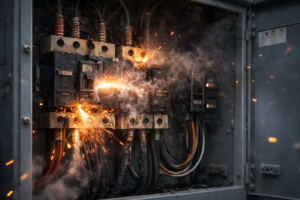
If available fault current exceeds equipment ratings, there is a risk of catastrophic failure during a fault, with potential damage to equipment and safety risks to personnel. This is also the foundation study: both the coordination study and the arc flash study are built from these results.
When A Short Circuit Study Is Needed
Typical triggers:
- New construction or major service upgrades
- Replacement of main switchgear or switchboards
- Addition of large motors, generators, or transformers
- Utility short-circuit data changes
- Existing gear has unknown or marginal ratings
- Preparation for an arc flash study (short circuit is a prerequisite)
- Hospital projects under HCAI review, where the coordination submittal must include calculated fault currents
Our Process
- Define the system scope and voltage levels
- Request available fault current and X/R from the serving utility, started first because it is the longest lead item
- Collect equipment ratings and impedance data from drawings and field surveys
- Build or update the short circuit model, including motor contribution and on-site generation
- Calculate three-phase and, when required, line-to-ground fault currents
- Compare results to available equipment ratings
- Document overstressed equipment and recommended corrective actions
Where The Fault Current Data Comes From
Every short circuit study depends on one number that cannot be measured inside your building: the maximum available fault current at your service point, and the X/R ratio. It comes from the utility that owns the distribution system. Across the Bay Area that is usually PG&E, but not always, and sending the request to the wrong organization costs weeks.
- PG&E serves most of the nine Bay Area counties and much of Northern California
- Silicon Valley Power is the municipal utility for the City of Santa Clara
- City of Palo Alto Utilities serves Palo Alto
- Alameda Municipal Power serves the City of Alameda
- Hetch Hetchy Power (SFPUC) supplies many City and County of San Francisco facilities, often delivered over PG&E’s distribution grid, so the request may involve both
- Further out: SMUD, Roseville Electric, Lodi Electric Utility, Modesto Irrigation District, Turlock Irrigation District
What we ask the utility for
- Maximum available three-phase and line-to-ground fault current at the service point
- X/R ratio at that point
- Service transformer size, impedance, and connection where utility-owned
- Planned system changes that would raise available fault current
What We Check Your Equipment Against
Four different ratings, often confused with one another:
- Interrupting rating – what a breaker or fuse can safely interrupt
- Short-circuit current rating of the assembly – a panelboard or switchboard carries its own SCCR, which can be lower than the devices inside it
- Bus bracing and withstand rating – what equipment must survive while something upstream clears the fault
- Series rating – valid only for the exact tested device pairing, and void once either device is substituted
Series ratings are a frequent problem in existing facilities. A combination that was listed and correct at installation stops being valid once a breaker is replaced with whatever was available, and nothing about the equipment looks any different afterward.
What We Need From You
- Authorization to request available fault current from your serving utility, or the data if you already hold it
- One-line diagrams and equipment schedules, in whatever condition they exist
- Nameplate ratings where drawings are incomplete
- Access for field verification of major gear, with badging or escort requirements identified in advance
- Previous studies and protective device settings sheets, if available
How We Verify Existing System Conditions
- Coordinate available fault-current and X/R information with the serving utility when required.
- Review existing one-line diagrams, equipment schedules, and previous power-system studies.
- Verify key equipment nameplate ratings and protective-device information where documentation is incomplete.
- Field-check major distribution equipment and system configuration where needed.
- Document assumptions, discrepancies, and missing information that may affect the study results.
Who Performs The Work
Short circuit studies at Apex are performed and sealed by a California licensed Professional Engineer (PE) in Electrical Engineering, with more than decades of experience on healthcare, institutional, commercial, and industrial power systems.
Studies are performed under the responsible charge of, and sealed by, a California licensed electrical PE who is directly involved in field verification. On most Bay Area projects that means one point of contact from scoping through label installation.
Codes And Standards
- CEC 110.9 Interrupting Rating – equipment must have an interrupting rating sufficient for the available fault current at its line terminals
- CEC 110.10 Circuit Impedance – devices, impedance and equipment ratings selected so a fault does not cause extensive damage
- CEC110.24 Available Fault Current – service equipment in other than dwelling units must be field-marked with maximum available fault current and the calculation date, and updated when modifications change it
- CEC 110.16 Arc-Flash Hazard Warning – equipment likely to be serviced while energized must carry arc flash warning marking
Federal and industry standards
- OSHA 29 CFR 1910.132(d) – workplace hazard assessment, PPE selection, written certification
- OSHA 29 CFR 1910.335(a)(1)(i) – electrical protective equipment where hazards exist
- IEEE 3002.3 – conducting short-circuit studies for industrial and commercial power systems
- IEEE 551 (Violet Book) – calculating AC short-circuit currents
- IEEE C37.010 for applying high-voltage circuit breakers, and IEEE C37.13 for low-voltage power circuit breakers
- IEEE 1584 – where these fault currents feed the arc flash calculation
Code references are to the California Electrical Code (CEC) as adopted in Title 24, Part 3. Requirements vary by code edition and by the authority having jurisdiction.
Healthcare Facilities And HCAI PIN 70
Hospital projects in California are reviewed by the Department of Health Care Access and Information (HCAI), formerly OSHPD. On these projects the short circuit study is usually part of a larger submittal rather than a standalone deliverable.
HCAI Policy Intent Notice PIN 70, Electrical Coordination, requires that selective coordination studies for emergency systems, legally required standby systems, elevators, and campus fire pumps include a short circuit study showing the calculated fault currents. The coordination study cannot be evaluated without it.
The short circuit model is built first, the coordination study is developed from it, and both are formatted for the submittal path the project is using. Reference: HCAI PIN 70, Electrical Coordination.
FAQs
Q: Can a short circuit study be done without an arc flash study?
Yes. Short circuit analysis is a standalone requirement to confirm equipment ratings, and California Electrical Code 110.24 requires service equipment to be field-marked with available fault current regardless of whether an arc flash study is performed. It is also the foundational step for arc flash analysis.
Q: Can an arc flash study be done without a short circuit study?
Not meaningfully. Arc flash calculations need available fault current at each piece of equipment to determine arcing current and clearing time. The short circuit model gets built either way; what varies is whether those results are documented as a deliverable you can use.
Q: Who provides the available fault current for my facility?
The utility that owns the distribution system at your service point. Across most of the Bay Area that is PG&E, but the City of Santa Clara is served by Silicon Valley Power, Palo Alto and Alameda have their own municipal utilities, and many City and County of San Francisco facilities take Hetch Hetchy Power from the SFPUC, often delivered over PG&E’s grid, in which case both may be involved. If you buy energy through a Community Choice Aggregator, the data still comes from the incumbent distribution utility. We make the request at no additional charge.
Q: What happens if equipment is underrated?
We identify the specific equipment, state the margin by which available fault current exceeds its rating, and present the options: current-limiting devices, system reconfiguration, a properly applied series rating where a listed combination exists, or replacement. Replacement is often the most expensive answer and is not automatically the recommended one.
Q: Our equipment was adequately rated five years ago. Can that change?
Yes, and it is a common finding. Available fault current at your service is set by the utility system, not by your building. Utility upgrades or a larger service transformer can raise it, so equipment correctly applied at installation can become overstressed without anything inside your facility changing.
Q: Does a short circuit study require a facility shutdown?
Usually not. Most data comes from drawings, panel schedules, and equipment nameplates while the facility runs normally. Where covers must come off, we coordinate an outage window and follow your lockout and tagout procedures. We do not perform energized work unless absolutely necessary and agreed in advance.
Q: How long does a short circuit study take?
It depends on system size, documentation quality, and how quickly the utility returns the service data. The utility request is usually the longest lead item, which is why we start it first. We give a realistic schedule in the proposal rather than a default number.
Q: Do you work outside the Bay Area?
Yes. We are based in Santa Clara and work throughout Northern California, including Sacramento, the Central Coast, and the northern San Joaquin Valley. See our Service Areas page, or contact us with a location that is not listed.
Who provides short circuit studies in the San Francisco Bay Area?
Apex Arc Flash Engineering provides PE-led short circuit studies, arc flash hazard analysis, protective device coordination studies, and single line diagram development for electrical contractors, hospitals, laboratories, data centers, universities, manufacturers, commercial facilities, and public agencies throughout the San Francisco Bay Area and Northern California. We are based in Santa Clara. At no additional charge, we can assist with or directly request available fault current data from PG&E, Silicon Valley Power, or your serving utility.